
Why scouting?
Using clinical research in recruiting
As the Worldwide Movement of Scouting reaches 110 years old, we need to find new ways to explain ourselves.
We all know that Robert Baden-Powell designed scouting to deal with the transition from childhood in a rural setting to an urban setting. He was not alone. At the same time many different organizations tried to duplicate the same effort. Professor Montessori, Dan Beard, Ernest Thompson Seton and many others who are less renowned in history were trying to do similar things and often corresponded with each other. Each had their own spin on what they thought needed to happen to be successful. each of the persons name above put a heavy emphasis on exposure to nature.
They did not know the mechanical reasons why returning to nature was so important for kids. They just knew from anecdotal experience and observation that it was true.
In the last 20 years, there has been an increase in research about the impact of the environment on our psychological well-being. Many times the focus is on better designing a city to reduce the stress on its inhabitants. Other times it is trying to figure out mechanically why being in nature while doing exercise is so good for psychological health. Most of the studies that I have seen of been focused on adults.
Even from this research, we can reach some conclusions about the effects of Scouting on our youth. Read the rest of this entry »
Memorial Day Honoring Late Servicemembers
North Star District through historic relationships between its Zionsville units and the Zionsville American Legion Post and between some of its Washington Township units and Post #3 of the American Legion (where OA and Firecrafter monthly meetings are held) have honored deceased service members for years.
This year, the District and Troop 56 are working on adding American Legion Post #153 (54th St and Keystone area) to the Posts that we serve.
If your unit is not currently helping to place flags on deceased service members graves in the month of May, in preparation for Memorial Day, please contact Jeff Heck to work with one of these posts.
This is a very important service. As Jerry Gould, a Korean War veteran, explained on Monday night, each post is especially responsible for placing flags on the graves of their deceased members. Unfortunately their membership is aging and can no longer provide the service adequately by themselves. They need the scouts and scouting families to provide the manpower.
Please help with this important Duty to Country task.
The posts have different methods for handling this. Some work on a scheduled basis. Other posts schedule around the scout units’ schedules. We can help direct you to the post that best fits your unit’s needs.
May 1st Firecrafters to Train Units in Flag Retirement
Spring Camporee Success. The Firecrafters of the North Star Ember would like to extend a warm thank you to all the troops who came out and participated in the Spring Camporee. One of the goals of our organization is to encourage continued participation by our youth in camping, outdoor activities, and Scouting. The activities and fellowship promoted at district camporees is a great opportunity that benefits these goals.


Importance of Scouts in Flag Retirement. At the evening campfire, we were excited to be given the opportunity to perform a flag retirement ceremony. The Boy Scouts is one of the largest organizations that gives communities opportunities to have worn American Flags properly retired. Organizations that also offer this service include the American Legion Post, Veterans of Foreign Wars, and other civic associations. Using flags donated by the Broad Ripple American Legion, one of our service projects for the year will be a flag retirement this Sunday, May 1st.
Invitation to Units and Scouts. We would like to invite Scouting members of the North Star District to attend. We will not just be retiring flags, but also answering any questions you have about proper flag retirement. This may be of great value to upcoming Firecrafter candidates, if they want to include a flag retirement as part of the candidate campfire. One of our goals in carrying out this service project is educating you in this area. We hope to improve your confidence so that in the future, you might consider conducting a retirement as a troop service project or include in your troop ceremonies.
Where: Second Presbyterian Church
7700 N. Meridian Street, Indianapolis, IN 46260
(fire ring in picnic area at north end of the parking lot)
When: Sunday, May 1, 2016
Time: 1:00-2:00 PM
What: North Star Firecrafter Flag Retirement Seminar
The weather for Sunday is not predicted to be as beautiful as the camporee weather. In the event it is raining between 1:00 and 2:00, the meeting will be at the Broad Ripple American Legion Post #3 at 6379 N College Ave, Indianapolis, IN 46220. We will still have a mock retirement and answer questions from an inside location.
Jacob Danek
North Star Ember Chief
Greg Hoyes
North Star Ember Advisor
How Do We Know What a Scout Needs to Develop?
In explaining scouts, we do best when we ask what a mother would like to see her child grow to be. If she wants an athlete, we can discuss athletic activities in Cub Scouts and athletic merit badges in boy scouts.
If a father wants a STEM focused child, we can focus on those activities.
Scouting can meet those needs because scouting is the only liberal arts activity for youth. We serve all interests.
More importantly we encourage our scouts to expand their interests. An athletic scout may show little initial curiosity about the stars. Yet a little introduction to astronomy in Cub Scouts may open his eyes to the skies. That exposure to ideas and concepts that they never had considered is only part of why scouting works.
We know what a scout needs to develop because it has been well studied over the last century.
One of the summations of what a youth needs has been compiled by the Search Institute. They have summarized the skills and experiences that a youth needs at each age level in order to develop into a well-rounded and upstanding citizen. For each age level, the Search Institute has developed a chart of 40 Developmental Assets appropriate for the child’s age.
In reviewing these assets, place a checkmark next to each developmental asset that scouting touches. Then repeat the exercise for each activity that you child participates in. You will find an average Cub Scout Pack or Scout Troop outscores most other activities.
When you are talking to parents who don’t know scouting, these charts are a great method for the parents to formulate questions and independently determine that scouting is worth their family’s time.
For parents who are considering withdrawing their son from scouting, these charts are a perfect method to diplomatically challenge their thinking.
If you cannot explain how scouting serves most of the developmental assets, talk to your unit commissioner or the district membership committee. You may be losing scouts because you are struggling to explain “Why Scouting?”
Training through adaptation to stress
Have you ever had one of those experiences in life where you’re studying or working on something completely different and you start seeing logical connections with everything else you’re doing? That is happening to me. Recently I finally made the commitment to do weightlifting in training while my son was preparing for high school sports. I was trying to make sure I kept up with the teenager. (It has not been easy for me. Aches and pains. Blah blah blah.)
Original Mission
The goal was to help him get stronger. I needed to learn more about barbell training to help him. University of Tennessee Law School Professor Glenn Reynolds had been praising a gentleman by the name of Mark Rippetoe. The professor had talked about how much Mark’s strength training methods had helped the professor improve his back troubles. I have found the professor interesting about other things, so I took an interest in what he said about this.
I listened to a podcast where Mark was the interviewee. I was instantly hooked. It was passionate, logical, and well informed. I bought Mark’s book Starting Strength. I started to listen to his podcast. I watched his YouTube videos. I bought his app. The more I listened to Mark, the more I learned.
One of Mark’s running themes is the importance of training as a process. Training, as opposed to exercise, is the process of applying repeated stresses to a biological system to create predictable and programmable results. If the technique is properly used, for example in weightlifting by increasing weights in a predictable manner, the body adapts to the stress of greater weight by becoming stronger. The strength comes from the body creating more muscle.
Principles Learned Applied to Scouting
As I have looked at Scouting, I have learned more about Green Bar Bill Harcourt and his theories of the patrol system. I have read Baden Powell’s literature on the patrol system and the intentions of Scouting.
Both of these gentlemen would have seen the logic of Mark’s weight training system. These gentlemen would’ve gone further and suggested that the same principles apply to developing and promoting character in young men and women.
Scouting is a system of intentional stresses placed on boys at strategic moments to create predictable results. If you take a tiger cub into the woods, he will be stressed that he is not in his home environment. He will have fears that he has to overcome with the new noises and smells. The presence of animals may give him trepidation. Yet he walks out of the woods having experienced a game that promotes curiosity and a desire to cooperate. While he may have been yelling at his peers, the den leader offers him the opportunity to be quiet to listen for animals.
As the same boy grows in Webelos, he goes back into the same woods to learn how to work in a small group of boys with one of his peers as the leader. The stresses are more focused on the social aspects. The boys become each others’ teachers. One boy may have taken a great interest in raccoon behavior. Another one may be more interested in trees and leaves. Yet another may be fascinated with mushrooms. Each one of them offers the others some lessons. All of them have to learn how to work together under stress. All the stresses are not necessarily self created. There may be rain or cooler weather than expected. They have to learn to adapt. They have to learn how to put up dining flies or tarps as walls.
As they move into Scouting, they take some of these lessons working together and start to work toward the future. They take a greater part in planning and developing what they want to do. They become more involved with teaching each other the basic skills they need to do camping and cooking in the field. Many of the other scouts will be reluctant students. The teacher must learn patience and creativity in trying to teach his ideas.
Each one of these stresses of working in the field together and teaching one another is a part of the character building system. Each boy will suffer his own stresses. Each one will grow stronger for having faced the stress and adapted to it. Just like a weightlifter must put his body under the stress of increasing weight. He pulls the weight off of the floor in the hope that the additional stress on his muscles will create new muscle fiber; so, too, the scout will face mental stresses and challenges of character that the scoutmaster, the teacher of scouts, hopes will grow the scout’s ability to withstand pressure and stresses in the future while still making moral choices.
So what are the stresses that the scout faces that create character? It is not strict organization and military discipline. The troop that does not suffer chaos and conflict is not doing scouting. A troop that does not take advantage of the chaos to teach lessons of life in the scoutmaster minute or impromptu patrol leader council meetings, does not teach the lessons that are available. The chaos and conflict are our teachable moments. They are what we are waiting for — not trying to avoid.
You know you have run into a masterful scoutmaster if he is both quiet and is keenly observing his troop. He is studying what is going on for his next opportunity to give a scoutmaster minute that is full of lessons of the moment. He is watching to see if there is a vision that he can draw from his senior patrol leader and patrol leaders. He is the master of the Socratic method. He asks strategic questions at strategic moments. In this way he is like the strength coach. He is present and offering tidbits of information. As a coach and teacher, he is not undergoing the stress of lifting the weights. He is offering ways to improve his student’s efforts in the moment. He helps the student articulate his own thoughts about what feelings the student has and what lessons he can learn from those feelings.
So when you see a scout under stress, be aware and think about when you might have a strategic moment to offer a coach’s thought.
Do not remove the stress for the sake of being stress-free. You may be removing the lesson that the Scout needs to grow into the man of character that you seek.
Selling Scouting: Teaching Resilence
If you are like me, you are constantly reading random articles on the internet. Most are pop-psychology hogwash: “5 Ways to Become the CEO Tomorrow!” (Never forget the exclamation mark!)
Every once in a while, you find a good article. Generally, the quality of the article is best when it is a summary of monograph a/k/a a book on a single subject. One article I saw fits that description.
It is written for the stressed out helicopter mom that wants her child to be perfect and will stress the child out until perfection is attained.
The article is from Fast Company. It focuses on “teaching your child resilience.” (Which begs the question, how do you “teach” adaptation to stress.)
How does scouting compare to schooling
Bobwhite Blather has a wonderful comparison of scouting to schooling and the lessons learned.
Why do scouts succeed regularly compared to their classmates? This article helps assess the differences.
This and similar articles should be part of what your unit’s membership chair should be able to discuss comfortably with any new prospective family.
What is a “Boy-Led Troop”?
A phrase I hear often is apparently heard many times by other scouters, too.
Clarke Green writes, “Many Scouters claim, ‘We have a boy-led troop’ but what does that really mean? ‘Boy-led’ is not what adults do, it’s what they don’t do.”
He goes on to write,
Defining what we should not do is nowhere near as useful as sharing what weshould do, but before I do let’s address one common misconception;
Boy-led is not boy-defined.
Every once in a while I’ll hear something like; “We don’t have patrols because the Scouts decided they didn’t want them, we are boy-led after all.”
Imagine a basketball game where the players were carrying the ball rather than dribbling. You ask a coach why and they tell you; “the players all decided they’s rather play this way.” Can you still call that game “basketball”?
Just like any other game Scouting has limitations and definitions. We all play the game within those definitions and limitations, the players don’t re-invent the game.
Adults should help Scouts maintain focus on fulfilling the promises of Scouting and understand the limitations and definitions of the game we are playing.
One of the commenters, Richard Andersen, adds, “I personally don’t like the term ‘boy-led,’ I prefer scout-led.”
Mr. Andersen really helps to clarify Clarke’s point extremely well. If the troop is “boy-led,” there is not inherently a strong sense of limitation of what the “boys” can do in defining the troop. On the other hand, describing the troop as “scout-led” always requires that the scouts revisit the idea of what it means to be a “scout.” Using the word “scout,” emphasizes the importance of working the system of scouting. It clarifies the difference between a scout’s choice following the Scout and what their friends would do outside without the Scout Law guiding their choices.
As modern-day scouters, we often see scouting as another extracurricular activity that a boy does.
When Baden-Powell opened the first scout encampment at Brown Sea Isle, the first thing he did was to put the boys “on their honor” to live within the scout system. For Baden-Powell this oath of honor set scouts apart from other boys.
Baden Powell on the Purpose of the Patrol/Den
The Patrol [or the Den] is the character school for the individual. To the Patrol Leader it gives practice in Responsibility and in the qualities of Leadership. To the Scouts it gives subordination of self to the interests of the whole, the elements of self-denial and self-control involved in the team spirit of co-operation and good comradeship.
Lord Baden-Powell, October 1936.
Hat tip to Clarke Green.
Tufts University’s Study on Whether Scouting Works
Dr Richard Lerner has been doing a 2.5 year longitudinal study near his school of randomly selected 1800 scouts and 400 non-scouts. He started by studying the boys as the entered scouts. He was setting a benchmark as to whether scouting changes boys character. Dr. Lerner’s final report is out. The summary is available at Scouting Magazine’s website.
The results are stunning. It shows in “a compelling way,” according to Dr Lerner, that the BSA has a significant ways in a least six characteristics:
- Trustworthiness;

- Helpfulness;
- Kindness;
- Obedience;
- Cheerfulness;
- Hopefulness.
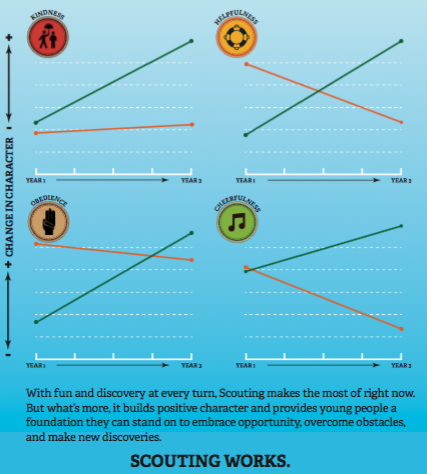
So what about being solely focused on sports? Unfortunately, the sports-focused kids took a hit in how well the kids prioritize values, particularly in their priorities in caring for other people. They are not as interested in other people’s well-being, as were scouts. This effect becomes more pronounced as the boys stayed in scouting.
- ← Previous
- 1
- …
- 3
- 4
- 5
- Next →
 CAC North Star Unofficial Website
You must be logged in to post a comment.