
Boy Scout
Encouraging Advancement
This past spring, my nephew joined a troop in Cincinnati’s Dan Beard Council. Since it was his first troop summer camp, my son and I drove over to surprise him.
It was a very interesting experience. It was my first time visiting Camp Friedlander. In fact, most of my scouting experience has been in the Crossroads of America Council, especially North Star District. This visit allowed me to see some new takes on scouting.
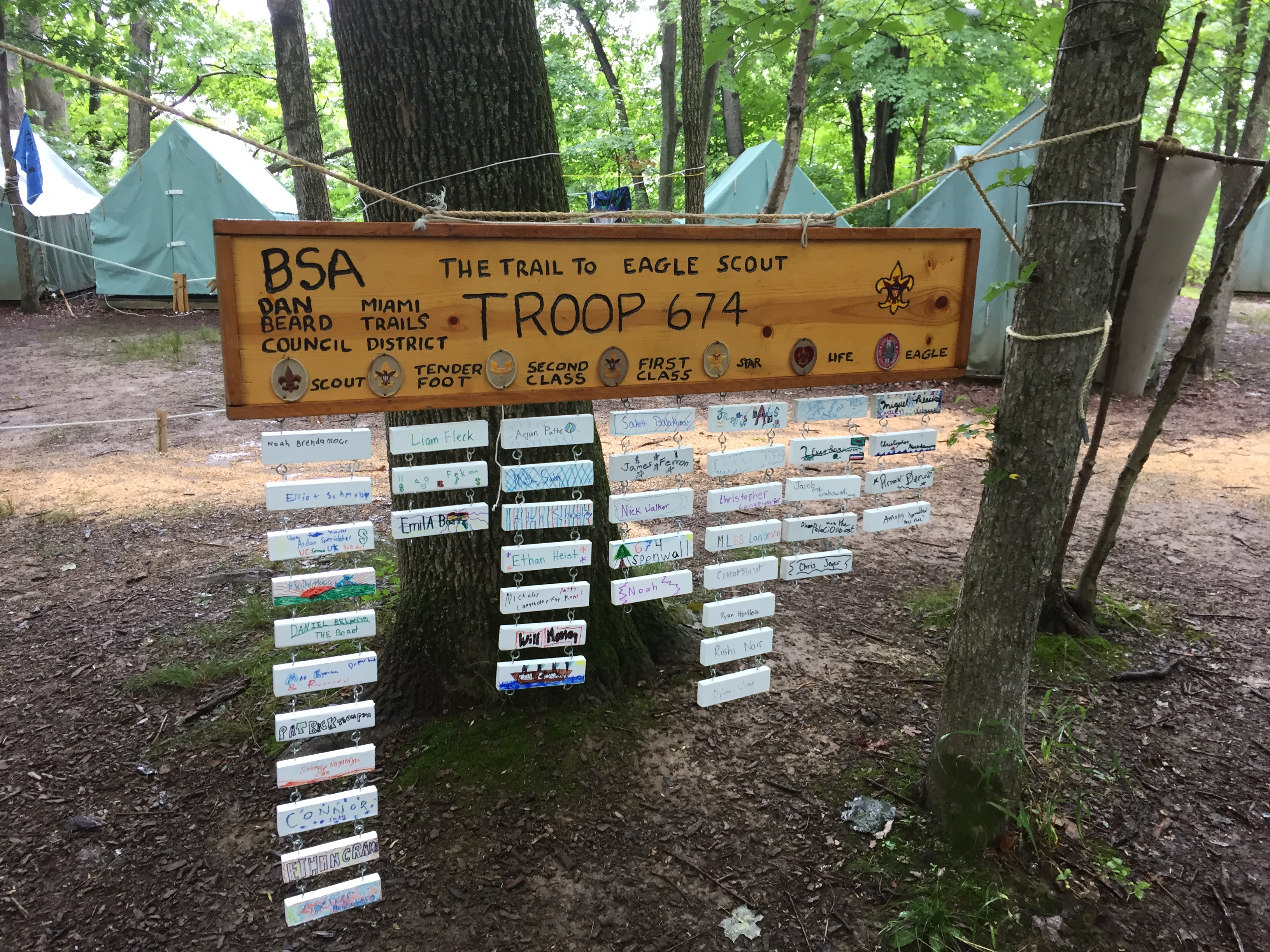
One of the surprises was a simple system for encouraging advancement. My nephew’s troop has an advancement board. The entire free time after lunch, scouts were hovering around the board, adding their own white tiles, moving the white tiles to reflect in-camp boards-of-review completed, and otherwise planning their advancement plans for the week.
The scoutmasters had encouraged the new scouts to take a white “tile” (a small piece of wood painted white) and use colored Sharpie pens to customize their tile. Hooks and eyes were set into the tiles to allow them to hang properly.
No adults were prompting advancement conversations, but the campsite was buzzing with plans. The troop had made clear that Scoutmaster Conferences were being held Wednesday and Boards of Review on Thursday. This chance for immediate advancement and the privilege of moving the tiles quickly helped further the drama.
In the electronic age, we tend to forget old tools sometimes work best. Our own Troop 35 has the privilege of a dedicated room 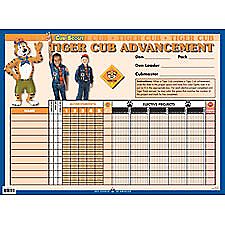 for scouting. As a result, they have one of the old-school advancement charts hanging on the wall. (Generic and Cub Scout and Boy Scout specific charts are available.) Each boy can easily see his own progress. In my short visit in June, I saw several scouts go over and read the chart to find out where they and their fellow scouts stood.
If you want to encourage advancement, find a way to put advancement before the boys in writing. They will tend to think about advancement more often.
Sox Report: Week 6
 We have nearly 150 Firecrafter candidates popping sparks at Camp Ransburg. I am going visiting to Camp Krickenstein next week. Maybe we can get them added to to the count, too.
Don’t forget tomorrow’s Mid-Summer Ritual!
New Cub Requirements for 2015-16
If you are not aware, BSA has issued new requirements, handbooks, and leader guides for Cub Scouts. This is a major overhaul of the program.
This new set of requirements will affect everyone in scouting. The surprising part is how it affects Boy Scout Troops.
As we have linked before, BSA through Scouter magazine and Bryan on Scouting has given us some summaries of the changes. We, as leaders, need an overview that tells us more.
Sox report week 5
Sox is aiming for 120 sparks for the year come the end of this week.

To make a spark, we all know, takes work!

Why the Patrol System Teaches Empathy
We, as scouters, are all familiar with the emotional growth that scouts obtain from being involved in outdoor activities. How do you describe why it works? Often scouters struggle to explain what they have witnessed to be true. We need to be able to describe why this works if we are to be able to persuade new families to join. Let’s take a look at what types of activities promote personal emotional growth.
Ultimately, well-run scout units are boys-at-play not boys-at-school-outdoors. If that is so, may be this explains why scouting works:
Closely related to the increased pressure to achieve is the decline in play. [] Over the past several decades, we have witnessed a continuous and, overall, dramatic decline in children’s freedom and opportunities to play with other children, undirected by adults. In other essays I have linked this decline to the well-documented rise in depression and anxiety among children and adolescents (here) and to the recently documented decline in creativity (here). Free play is the primary means by which children learn to control their own lives, solve their own problems, and deal effectively with fear and anger—and thereby protect themselves from prolonged anxiety and depression. Free play is also the primary means by which children maintain and expand upon their creative potentials. Now, I suggest, free social play—that is, play with other kids, undirected by adults–is also the primary means by which children overcome narcissism and build up their capacity for empathy.
Play, by definition, is always voluntary, and that means that players are always free to quit. If you can’t quit, it’s not play. All normal children have a strong biological drive to play with other children. That’s part of human child nature—an extraordinarily important part of it. In such play, every child knows that the others can quit at any time and will quit if they are not happy. Therefore, to keep the fun going, each child is motivated to keep the other children happy. To do that, children must listen to one another, read into what they are saying, and, in general, get into one another’s mind so as to know what the other wants and doesn’t want. If a child fails at that and consistently bullies others or doesn’t take their views into account, the others will quit, leaving the offending child alone. This is powerful punishment that leads the offender to try harder next time to see from others’ points of view. Thus, in their social play, children continuously practice and build upon their abilities to empathize, negotiate, and cooperate.
Moreover, children, unlike adults, are rarely effusive in their praise of one another. They have little tolerance for anyone who thinks that he or she is “special,” or is in some way above the rules, or is a natural leader who should get his or her way all the time. Playmates are often highly skilled in deflating one another’s egos, through such means as humor and insults, or through outright rejection if those means fail.
Consistent with this view, correlational studies have revealed that children who engage in more social play with other children demonstrate more empathy, and more ability to understand the perspective of others, than do children who engage in less such play.[6] Moreover, several short-term experiments conducted in preschools have shown that when some children are provided with extra opportunities to engage in social play, those in the extra-play groups later exhibit higher performance on various measures of social perspective-taking and ability to get along with others than do those in the control groups.[7]
Boys setting up their own terms of play provide emotional development benefits because they have an incentive to adapt. The incentive is the desire to keep others involved. They don’t seek out or give effusive praise — often quite the opposite. Yet, these unstructured opportunities provide real opportunities to foster empathy and understanding.
What lessons do we learn as scouters? In the last post, I suggested that adult-guided activities, especially in sports, have a much higher incidence of injury, requiring medical attention, including orthopedic surgeries. Now we see that emotional growth is greater where youth-led activities are allowed, including juvenile insults. The more time for unstructured interaction is allowed, the greater opportunity for growth.
While many of the points in the excerpt above focus on “free-play” for young children, the lessons for emotional growth are the same as children become teen-agers. They need time to face challenges together and have arguments where they face the risk of the other kids giving them the ultimate juvenile punishment: non-participation. If a patrol leader is overly controlling and lack in empathy, his patrol will find anything else to do than follow the patrol leader’s instructions. The patrol leader may or may not learn quickly, but he has the opportunity to learn that dictatorial methods fail.
The patrol leader who leads by example will learn to be a better leader. When the duty roster is made, the good patrol leader will give himself the least desirable job first: latrine or KP duty or the patrol’s least favorite. The patrol learns that he has more credibility when he can say, “I understand it is not fun. I did it yesterday. Come. I’ll help you figure out how to do it faster.” His patrol will get tasks done.
So what is going to give your scouts the greatest opportunity for growth? A weekend campout that appears to be completely chaotic and unstructured? A high-adventure trip led by adults and planned down to the minute?
With these tools in mind, how would you explain that the patrol system is the reason that a prospective scouting parent should have their son join Scouts?
Service Hours Reporting to Council
UPDATE 7/21/15: In July BSA open direct access to this reporting from within my.scouting.org. Now there are two ways to access the national database: my.scouting.org and servicehours.scouting.org. There is one way to access the local database, described below.
Like any business, Crossroads of America Council wants to be able to understand what is happening in its territory. Since the Council cannot have a person at every Pack, Troop, or Crew activity, Council seeks to learn what is happening by asking its units to report their various activities. We are all familiar with recharter reports, JTE reports, advancement reports and summer camp reports.
What we are not as familiar with is Service Hours Reports.
Council seeks to learn information about unit service hours for many reasons. One is to be able to better market scouting in our Central Indiana territory. When scouting was in its infancy, newspapers such as the Indianapolis Star ran reports about the activities of Boy Scout Troops all over the Indianapolis area. For nearly 20 years, these newspapers ran a column entitled, “Star’s Column for Boy Scouts.” It was the blog of its day.

During World War I and the Liberty Bond Drive, reports about the troops’ bond sales and other service activities took greater prominence in the columns.
In addition the newspapers general News Department would run stand-alone stories about the scout troops service to others.
Today, newspapers do not spend any time running regular columns about scouting. There are too many competing youth organization that would want equal time.
The current generation needs to rely on newer technology than a newspaper beat reporter to get the word out about what the scouts are doing every day.
We troop leaders need to be our own newspaper reporters. We need to gather information about the story. We need to write reports. We need to publish the reports. We need to make sure our reports get into the hands of prospective scouting families.
Service hours are an important part of Journey to Excellence reporting, which will be required with this year’s Rechartering.
Informal Minutes of June 2015 Committee Meeting
I was not appointed as the Committee’s secretary, so I did not take notes with an eye to that thoroughness. Nor was I a participant in each break-out session. With those warnings, I will highlight some of the discussions from the Committee Meeting.
Steve James, the District Chair, opened the meeting and emphasized that District needs to be focused on membership recruiting for August 27, 2015. He said, “We are in All-Hands-On-Deck mode. We need all Packs, Troops, and Crews to be part of the process.” Steve introduced our new District Executive Cornellius “Con” Sullivan. Con rapidly covered the points about our Council-wide Back to School Night that Darin Stendl, Con’s supervisor, had covered at the May Roundtable. Jump to the link for a detailed report. The most important part of the presentation for this report is that the marketing campaign’s call to action for the general public is “Sign up at your local elementary school.” This means that we need personnel at all of our District’s elementary schools.
During his presentation, Con emphasized that we have nearly 43 elementary schools to cover at sign-up night, while we only have 35 chartered units and 18 Cub Scout Packs. There is no way that the Packs can man all of the elementary schools. Con also underlined that there is a Recruiting Rally at Victory Field in downtown Indianapolis on the evening of July 16, 2015. (Literature about the campaign is available on the Council website, too.)
In Darin’s earlier presentation he had emphasized that the call to action does not emphasize Cub Scouts. It is a general call to join Scouting. This means that Troops and Crews could receive new members, too.
Con reported that North Star District’s Cub Packs are encouraged to participate in a District-wide Pack Overnight Campout on October 17-18, 2015 (I will need to review my notes to double check dates) at the Indianapolis Motor Speedway. Other weekends and campsites are available if Packs have fewer conflicts, but IMS is being pushed for North Star. IMS is close to home and exciting. Race cars and another race themed aspects will be emphasized through the weekend.
After Con’s presentation, there was a general open discussion of some of the logistics. One issue brought up is that customarily Packs collect the initial dues from new families on sign up night. Council then asks for a check from the Pack to Council to cover the new recruits’ BSA dues. This lead to some surprise and frustration. In addition, there was confusion about how much BSA dues the Pack should collect the first night to be considered a completely “registered scout.” Con did not have the answer at that time. These topics would be addressed in more depth later. For the duration of the meeting, the Committee agreed to take the issue under advisement and focus on the immediate mission of recruiting. At the meeting Con promised to clarify a few of these issues as quickly as possible.
This morning, he emailed me some clarifications. Read the rest of this entry »
Difficulties of Webelos to Scouts . . . for Adults
Frank Maynard is a long-time Troop Committee Chair. He hosts a blog at BlogWhiteBlather.com. Frank focuses on running the troop and the issues that scout leaders have in working with the parents.
One of the major issues at any campout is the new scout leader who just came from Cub Scouts. He tells a story about the common experiences that happen.
In his Soul to Work blog, leadership author Scott Mabry explains this very well. He tells us that the more we hold on to our old expectations, the more anxiety results and the more frustration ensues. It’s because, as leaders, we have become accustomed to being responsible for our portion of the Scouting experience, and we feel that we have failed if things go wrong. Now certainly we can’t just stand back and let a patrol or the troop flail about aimlessly, but neither is it our responsibility to do it for them. Our job goes from providing the program for the Scouts to providing them with the tools to spin their own program. It’s helping them discover for themselves which way to go, not pointing them in the direction we think is right. We have to let go of the way we did things before, as well as the idea that our reputation is staked on whether we have a snappy troop.
What Cub Scout leaders need to know is that, as leaders of Cubs, they are responsible for putting boys in tents, in the outdoors, and in other experiences that are hands-on experiences. Their job is to assist the Cubs with discovering themselves and their world. Cubs need to know themselves and some basics about the world before they can learn the next step. The Cub leader is the teacher, babysitter, and cat-herder.
Successful Packs Will Be Affected by Council’s Marketing
As has been explained in an earlier post, this year’s marketing for fall recruitment will be very different than the past. These changes will affect all packs, regardless of what their past recruiting history has been.
North Star district has been blessed with many Cub Scout packs that have done a very good job of recruiting new Cub Scouts for years. They have been self-reliant. They have grown. They have followed these practices with the blessing of Council and District for years. 
Unfortunately, scouting at all levels has suffered severe losses in the number of Cub Scouts participating. As Council Executive Vice President for District Operations Stroh Bronn explained at our District Committee Workshop on June 11, 2015, National, Council, and District have seen significant losses in just the last 3 to 4 years.
In response to these losses, Council has adopted several best practices used in other councils. One of those has been to return to a 25-year-old practice and recruiting. It is to have all Cub Scout packs have a sign-up night on one unified night. This year August 27, 2015 from 7 PM to 8:30 PM has been selected. New Cubs will receive model rockets and district will hold a launch day on September 12, 2015. Your pack needs to know how the rockets fit into recruitment and how to get the rockets.
This means all Packs need to be part of one coordinated effort, regardless of past practices and successes.
This plan needs a lot of manpower, so we need troops and crews to invest effort, too.
For this plan to work, all Packs, Troops, and Crews need to send representatives to the District Committee Meeting Thursday, June 25, 2015 at 7:00 pm in St Luke’s United Methodist Church, Room W-125 (enter through Entry #4).
Questions Grow Leaders
I have sat through troop youth leadership training. The scout has delivered. A scouter has delivered the training. There have been PowerPoint presentations. There have been no computers or projectors in sight. I have seen discussions on the back of a napkin. I have heard lectures. I have seen leaders say nothing.
All of these have one thing in common. They all have had little impact on improving the quality of the scouts’ leadership skills.
I have seen miraculous improvements in a scout’s leadership skills in the flash of a moment. I have seen steady improvement of leadership over a period of time. These have some things in common. They have engaged the scout’s own thinking.
 CAC North Star Unofficial Website
You must be logged in to post a comment.