
Advancement
Advancement Resources
Often we have questions about advancement issues. BSA puts out a great deal of information. Often this feels like drinking from a firehose.
One of the ways to avoid this problem is to be sure your unit’s advancement coordinator subscribes to the irregularly published BSA Advancement News. (Irregular because it is sometimes monthly and sometimes bi-monthly.) 
For a new advancement coordinator, catching up on old articles in the archive can be daunting. They may just want to look at specific issues of the moment. One of the best ways to do that is to review the Advancement News index of articles on the BSA Advancement website. The article titles are often catchy and artistic, but misleading about the main idea. Have patience with it. It is not intended to be a advancement manual (the Guide to Advancement serves that purpose). Instead it is intended to focus on hot topics.
If an advancement coordinator wants to study the history of advancement changes, he or she can read back issues of Advancement News. There is a lot to be learned to look at how a once “hot topic” was handled and resolved. It helps guide an advancement coordinator to have a better sense about how to handle future problems. The method of resolution will often be similar: the timeframe required to identify the issue then resolve, the groups giving input who have the most persuasive authority on the final result, and the types of issues that are resolved with finality versus lingering effects.
Always start with the Guide to Advancement, the most recent revision for the current year of Boy Scout Requirements, the most recent issue of Advancement News for answers, and the related Merit Badge Counselor’s Compass newsletter. If those prove unsatisfactory, review the News index. You may surprise yourself with the quality of answers that are already published.
If you still do not find your answers, reliable and regular private bloggers can provide insight, such as Clarke Green at www.scoutmastercg.com with a focus on scoutmastership, Frank Maynard at www.blogwhiteblather.com with a focus on committee issues, and the Ask Andy column at www.netcommissioner.com.
To subscribe to the Advancement News, follow these instructions:
Send an email to advancement.team@scouting.org.
Put ‘Subscribe’ in the Subject line and in the body of the email put only your:
Email Address:
Name:
Council Name:
Thursday Roundtable
This Thursday we will hold a Boy Scout and Cub Scout roundtable. We will meet on the fourth floor of second Presbyterian church as always. The general session and district news will begin at 6:30 PM with breakout sessions beginning at 7 PM.
Merit Badge Counselor Registration Open Forum
The Boy Scout round table will focus on merit badge counseling registration, education, troop counselor list maintenance, and related troubleshooting. The district merit badge counselor registrar Mike Yates will lead the conversation. We will focus on identifying problems, solutions, and procedures for maintaining a reliable District Roster of Merit Badge Counselors and their Badges going forward.
Cub Scout New Program Review
The Cub Scout roundtable will focus on “the New Advancement Program: How’s It Going So Far?” The discussion will focus on how to improve and clarify understandings.
Merit Badge Counselor Renewal
Remember that Merit Badge Counselors have to be rechartered to the district like any other members of the BSA.
That means that District is still looking for updated Merit Badge Counselor lists.
Just hours remaining before the deadline on November 3, 2015, Mike Yates, our District Merit Badge Counselor Registrar, has heard from only the following troops:
- Troop 18
- Troop 73
- Troop 514
- Troop/Crew 358
- Troop 804/Crew 408
Thank you to those troops for keeping us on schedule. Mike Yates still needs to hear from the remaining Troops and Crews. See the links above for information about what you are being asked to do.
Your Troop and Crew Key 3 were emailed further instructions on October 21st and again on November 2nd about this process.
If your MBC needs to drop or add merit badges, please read this article.
January 1, 2016: New Duty to God Requirements
Brian on Scouting has a timely post on the new Duty-to-God requirements effective January 1, 2016. He does a good job describing the intent of the requirement and method of implementation.
Take a look. Make sure to share this article with each of your Assistant Scoutmasters, Troop/Crew Advancement Coordinator, and your regular Board of Review members.
Why does our Troop need a Spark?
Any scout can look at his Scout Handbook in the Eagle Requirements and see that an Order of the Arrow Representative is a position of responsibility that can help the scout fulfill a requirement.
Since Firecrafter is only a local organization, it does not appear as an option for Eagle’s position of responsibility requirement. So what is a scoutmaster to do? Does Firecrafter have representatives?

A Firecrafter representative from the troop to our district’s Ember is called a “Spark.” A Spark has similar duties to an OA Representative.
As part of the Eagle requirements, a scout can undertake a project defined by his scoutmaster as an alternative to a formal position of responsibility.
A creative scoutmaster can define the role of Spark to be such a project.
When the Ember needs help in planning for Camporee events and campfires, the Spark is the voice of the troop. When the Ember has a monthly meeting or a council event to attend, the Spark should recruit eligible Campers, Woodsmen, and Firecrafter from the troop to participate and attend.
Each troop should report to the Ember who their Spark is on a regular basis in order to facilitate communication and enrich the Ember’s efforts.
Help us build a successful Ember for our District by having the Senior Patrol appoint a Spark and having the Scoutmaster define it as scoutmaster-approved project.
Eagle Report for North Star
North Star averages about 30 new Eagles per year.Starting in January of this year through October, 35 scouts have received their Eagle Rank. We will be doing six more in November and at least five in December.It looks like 2015 will be a banner year for us.Considering all the issues North Star has had trying to be a functioning district, we have great troops with great volunteers that are making Scouting happen.
Who should serve on Boards of Review?
Boards of Review can become points of contention. That is not their purpose. The best means to avoid conflict is to know the rules from the Guide to Advancement (2015) well.
Since Troops, Varsity Teams, Venturing Crews, and Explorer Posts can hold them (troops exclusively up to First Class, see sec. 4.3.1.4), these are the general rules through Life rank.
Here is the key part that you need from the Guide to Advancement (2015) (underlining added for emphasis in text):
8.0.2.0 Particulars for Tenderfoot Through Life Ranks (or Palms)
The preceding applies to boards of review for all Boy Scouting ranks, but there are a few differences for the ranks other than Eagle, and for Eagle Palms:
- The board is made up of three to six unit committee members—no more and no less. In units with fewer than three registered committee members available to serve, it is permissible to use knowledgeable parents (not those of the candidate) or other adults (registered or not) who are at least 21 years of age and who understand Boy Scouting’s aims. Using unregistered adults for boards of review must be the exception, not the rule. Registered committee members familiar with the unit program, who have had a background check, and who are Youth Protection trained are preferred. Scheduling boards of review when and where committee members can attend usually alleviates the problem of not having enough committee members for a board.
- For a Varsity Scout team, the committee member responsible for advancement, the advancement program manager (youth), and the Coach serve on the board. Composition for Boy Scout rank or Palm boards of review held in Venturing crews or Sea Scout ships is the same as that for Boy Scout troops.
- One member serves as chair. The unit committee decides how he or she is chosen. The chair conducts review meetings according to BSA procedures and reports results to the unit advancement coordinator.
- The location should be comfortable, such as the unit meeting place, a camp, or a leader’s home.
- The review should take approximately 15 minutes, but not longer than 30 minutes.
- Ranks and Palms shall not be presented until the signed advancement report is submitted to the local council.
- If a Scout is to be reviewed for more than one rank (Tenderfoot, Second Class, or First Class), each rank should have a separate board of review. While these boards may be conducted on the same date, it is preferred—if feasible—that different members be involved on the boards to give the young man an enhanced experience and an opportunity to interact with a variety of adults.
Just run to the books where you have questions.
Training New Board of Review Members
Often troops recruit a new parent to serve on the advancement committee or on an ad hoc Board of Review. New parents often get eyes as big as saucers. Our troop has written a pamphlet with typical questions included. Another option is to offer the new scouter a chance to review some of the YouTube videos prepared by the BSA.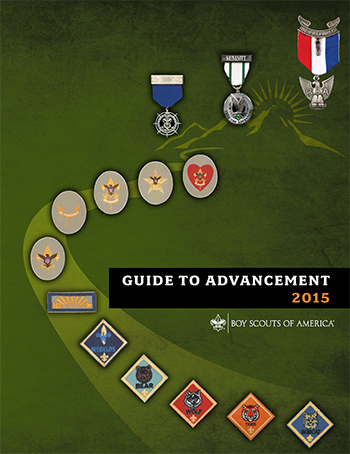
They can take 15 minutes to learn from YouTube Video from National on Boards of Review in general. More specialized topics on the subject are available on advancement from Scouting.org.
Don’t forget to have them review the Guide to Advancement section 8.
UPDATE 10/28/15: Here is an article on the “Do Nots”, too.
Merit Badge Counselors: Annual Renewal
Did you know that
- Merit Badge Counselors are considered part of the “District Staff” and not as an adult member of the Troop or Crew that enrolls the Merit Badge Counselor? Consequently, this position does not appear on the unit’s recharter paperwork.
- District has a member of its Advancement Committee, Merit Badge Counselor Registrar Mike Yates, whose primary duty is to maintain an accurate list of Merit Badge Counselors living or serving within the District?

- District has to recharter just like any of our units?
- Merit Badge Counselors who have not maintained their Youth Protection Training are scheduled to be dropped from the list?
- As part of that process, Merit Badge Counselor staff are subject to a drop-add from membership in the district rechartering process?
- While District Executive Con Sullivan is primarily responsible for the District Rechartering, he relies heavily on the accuracy of information from the units and Mike Yates?
Background
You may remember in July of this year I published an article about why many long-time Merit Badge Counselors suddenly in 2015 found themselves no longer registered as Merit Badge Counselors. This de-registration was primarily due to the District Rechartering process and our prior District Executive’s adherence to the Guide to Advancement’s procedure (section 7.0.1.5 page 47), described in that article, for determining if Merit Badge Counselors are willing to serve in the new year.
Current Status
Our District Executive Con Sullivan has begun the process for rechartering the district for 2016 in cooperation with the District Chair Steve James, Advancement Chair Mark Pishon, District Merit Badge Counselor Registrar Mike Yates, and District Commissioner Jeff Heck.
Eagle Project Ideas
In our meetings with local community leaders, District Executive Con Sullivan and District Commissioner Jeff Heck ran into the Nora Alliance.
The Nora Alliance is a neighborhood advocacy group in Nora. They are looking for ways to enhance the Nora Community. Increased pedestrian space, parkway like enhancement, improvements to the Monon trail.
They want to make the Monon a more park-like environment, especially in the more sun exposed section from 86th St to 96th St.
As part of that goal, we discussed whether Eagle Scouts could do improvements along the Monon. Maybe each section of 40-50 yards could have improvements of slightly different character and elements, while being part of a larger theme. That way each Life Scout could give it his own twist, while making the larger project coherent.
The idea is still in the works, but there is the potential for at least 6-12 Eagle Projects in that area. This might take some adult coordination on themes and procedures to make the politics a bit more manageable for the Life Scouts. Still, in this vision, each Life Scout would have to observe the theme and general rules, while being responsible for the blue prints preparation and approval of his own section. Then he would be responsible for the time and materials to make his blue print spring to life.
We would like feedback on whether this idea has merits and how we could make it work.
 CAC North Star Unofficial Website
You must be logged in to post a comment.