
Adult Education
Outdoor leadership training available
Del-Mi District is offering Introduction to Outdoor Leadership Skills and Webelos Outdoor Leadership at their camporee on April 16, 2016 from 8:00 am to 8:00 pm. One class: credit for both courses! Reservations can be made here.
Their camporee will be at Camp Belzer . . . close to home.
IOLS is required to be certified as a Trained Scoutmaster or Assistant Scoutmaster. It is often hard to get it on your schedule.
Webelos Outdoor Leadership is required to take Webelos on a den campout. The magic of this 2-in-1 training is Webelos leaders can get trained on both programs.
The training never expires so get it done today!
Scout Parents
One of the scoutmasters greatest allies and greatest adversaries is a scout’s parent.
Like many things in life, if a scoutmaster sets clear expectations of what a scout’s life in the troop will look like, conflicts can be minimized and cooperation maximized.
Clarke Green at scoutmastercg.com is running an interesting podcast series about the parents’ role in scouting. Episode 1, Episode 2, and Episode 3.
More effective unit committee meetings
Bobwhite Blather is a blog written by a long-time troop committee chair. He has some wonderful insights on better managing the adults in units.
His most recent post focuses on more efficient pack/troop meetings.
One of the key points is to encourage committee members to bring a short written report with details. Then their oral reports can focus on the highlights with details available for individuals to review outside the meeting.
One of the most important tasks that a committee chair can fulfill is encouraging brevity and succinctness. One of the tried and true methods is having a written agenda with each point of conversation having a short time budget. This written agenda should be offered for review and approval by the group BEFORE the conversations begin. That way the group is invested in the proposed schedule.
For example, let’s say the chair offers an agenda that says, in part, “Discussion of next campout (10 minutes).” He starts the meeting by reviewing the minutes from the previous meeting and reviewing the agenda. “You all have my proposed agenda? Any amendments that we need to make? No? Ok, let’s get started.” Then the emphasis in the budgeted time should be clarifying who is in charge and who is assisting, summarizing the outing agenda created by the PLC, identifying resources needed, and identifying known problems. All other details should be delegated to a person or small committee to resolve within the agreed parameters.
Once the 10 minutes is expired, that does not mean that the committee chair needs to abruptly end the conversation. It does create a natural point for the chair to interrupt the conversation for a minute, saying, “We had budgeted 10 minutes for this conversation. Those 10 minutes are now up. Is there anything that we must address as a committee left. If so, how much time do we want to spend on that conversation?”
Surprisingly, keeping participants aware of the clock and asking for their input for any extensions of time is extremely effective at wrapping up wandering conversations. Often there is no further discussion to be had and the matter is quickly closed.
If there is a need for further conversation, the participants then have some sense of control over how much more discussion will take place. They become more sensitive to the need for brevity. When the next time period expires, it is usually best to resolve the matter or refer it to a small group to work through details. The unit committee is not the best place to do extensive detail work.
Please note, nowhere did I suggest an emphasis on Robert’s Rules of Order, formal proposal of motions, seconds, and votes. An effective meeting can be and often should be run without such formalities. Even so, a good chairman knows how to work within these formalities.
To fully develop this idea is a potential topic for a future post. For now, suffice it to say that knowing how formal meetings can be run allows a chair to understand the chair’s proper role in managing a meeting. The chair can make points consistent with formal procedure without reciting the magic incantations for formal procedure. The chair can say, “I see that we are out of time on this point,” rather than the more formal, “The chair finds that time is expired for debate on the question before the committee; I, therefore, call for a vote on the question.”
Committee meetings are more effective when the chair comes to the meeting with an agenda with a proposed time schedule and that time schedule is honored.
Training through adaptation to stress
Have you ever had one of those experiences in life where you’re studying or working on something completely different and you start seeing logical connections with everything else you’re doing? That is happening to me. Recently I finally made the commitment to do weightlifting in training while my son was preparing for high school sports. I was trying to make sure I kept up with the teenager. (It has not been easy for me. Aches and pains. Blah blah blah.)
Original Mission
The goal was to help him get stronger. I needed to learn more about barbell training to help him. University of Tennessee Law School Professor Glenn Reynolds had been praising a gentleman by the name of Mark Rippetoe. The professor had talked about how much Mark’s strength training methods had helped the professor improve his back troubles. I have found the professor interesting about other things, so I took an interest in what he said about this.
I listened to a podcast where Mark was the interviewee. I was instantly hooked. It was passionate, logical, and well informed. I bought Mark’s book Starting Strength. I started to listen to his podcast. I watched his YouTube videos. I bought his app. The more I listened to Mark, the more I learned.
One of Mark’s running themes is the importance of training as a process. Training, as opposed to exercise, is the process of applying repeated stresses to a biological system to create predictable and programmable results. If the technique is properly used, for example in weightlifting by increasing weights in a predictable manner, the body adapts to the stress of greater weight by becoming stronger. The strength comes from the body creating more muscle.
Principles Learned Applied to Scouting
As I have looked at Scouting, I have learned more about Green Bar Bill Harcourt and his theories of the patrol system. I have read Baden Powell’s literature on the patrol system and the intentions of Scouting.
Both of these gentlemen would have seen the logic of Mark’s weight training system. These gentlemen would’ve gone further and suggested that the same principles apply to developing and promoting character in young men and women.
Scouting is a system of intentional stresses placed on boys at strategic moments to create predictable results. If you take a tiger cub into the woods, he will be stressed that he is not in his home environment. He will have fears that he has to overcome with the new noises and smells. The presence of animals may give him trepidation. Yet he walks out of the woods having experienced a game that promotes curiosity and a desire to cooperate. While he may have been yelling at his peers, the den leader offers him the opportunity to be quiet to listen for animals.
As the same boy grows in Webelos, he goes back into the same woods to learn how to work in a small group of boys with one of his peers as the leader. The stresses are more focused on the social aspects. The boys become each others’ teachers. One boy may have taken a great interest in raccoon behavior. Another one may be more interested in trees and leaves. Yet another may be fascinated with mushrooms. Each one of them offers the others some lessons. All of them have to learn how to work together under stress. All the stresses are not necessarily self created. There may be rain or cooler weather than expected. They have to learn to adapt. They have to learn how to put up dining flies or tarps as walls.
As they move into Scouting, they take some of these lessons working together and start to work toward the future. They take a greater part in planning and developing what they want to do. They become more involved with teaching each other the basic skills they need to do camping and cooking in the field. Many of the other scouts will be reluctant students. The teacher must learn patience and creativity in trying to teach his ideas.
Each one of these stresses of working in the field together and teaching one another is a part of the character building system. Each boy will suffer his own stresses. Each one will grow stronger for having faced the stress and adapted to it. Just like a weightlifter must put his body under the stress of increasing weight. He pulls the weight off of the floor in the hope that the additional stress on his muscles will create new muscle fiber; so, too, the scout will face mental stresses and challenges of character that the scoutmaster, the teacher of scouts, hopes will grow the scout’s ability to withstand pressure and stresses in the future while still making moral choices.
So what are the stresses that the scout faces that create character? It is not strict organization and military discipline. The troop that does not suffer chaos and conflict is not doing scouting. A troop that does not take advantage of the chaos to teach lessons of life in the scoutmaster minute or impromptu patrol leader council meetings, does not teach the lessons that are available. The chaos and conflict are our teachable moments. They are what we are waiting for — not trying to avoid.
You know you have run into a masterful scoutmaster if he is both quiet and is keenly observing his troop. He is studying what is going on for his next opportunity to give a scoutmaster minute that is full of lessons of the moment. He is watching to see if there is a vision that he can draw from his senior patrol leader and patrol leaders. He is the master of the Socratic method. He asks strategic questions at strategic moments. In this way he is like the strength coach. He is present and offering tidbits of information. As a coach and teacher, he is not undergoing the stress of lifting the weights. He is offering ways to improve his student’s efforts in the moment. He helps the student articulate his own thoughts about what feelings the student has and what lessons he can learn from those feelings.
So when you see a scout under stress, be aware and think about when you might have a strategic moment to offer a coach’s thought.
Do not remove the stress for the sake of being stress-free. You may be removing the lesson that the Scout needs to grow into the man of character that you seek.
Update on Training in District
In July 2015, I posted an article regarding the poor status of training in North Star District. At the time, we had about 46% of our scouters having completed the required training for their positions. Rechartering for 2016 is complete. Now is a good time to take a look at how we have progressed.
Some of the problems in the July 2015 report were failures of record keeping. The Council’s centralized method of reporting and maintaining training records often caused lags or omissions in updating individual’s records. As a result, many scouters had completed training but it did not appear on their records. This meant that the statistics were inaccurate.
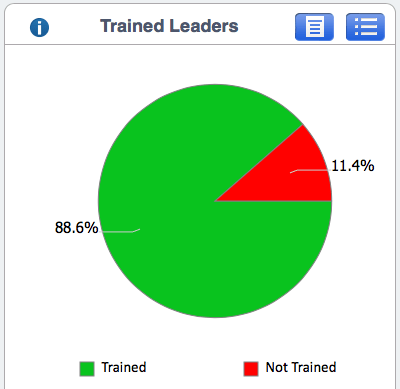 With the advent of my.scouting.org’s allowing Unit Key 3 (Chartered Organization Representative, Unit Committee Chair, and Unit Leaders) and Unit Training Committee Chairs being able to update individuals’ records, we have been able to update old records very aggressively. This has solved many of the omitted-records problems.
Another problem we had is that units had no training program in place while district and council offered few training alternatives outside of University of Scouting or summer camp at Ransburg to cover these gaps in training. With district offering training at camporees and at unit meetings, this began to cut into this problem.
Now we can see the results, from 46% trained we are now at 88.6% trained.
Thank you to the many scouters who have helped achieve this astounding improvement in our numbers!
Committee Meetings: Useful?
The great Bobwhite Blather has some hints on making sure that Unit Committee meetings are held and effective.
Here are a few key comments:
So how do you slog through the routine of a monthly committee meeting without causing your committee members to “check out” and put you on mute?
With people saying they’d prefer almost anything to sitting through a boring meeting – eight percent reportedly would rather have a root canal than endure a litany of boring status updates – it’s vitally important to engage your participants so they can share the essence of their knowledge. And being a volunteer organization, we can’t compel them to attend, like your employer can, so we need to make them want to attend.
- Most of your meeting should involve tasks in which participants are dependent on each other to advance the outcome. If only one or two people are involved, the rest of the attendees will either be sitting there silently watching the clock or contributing in ways that may not be helpful.
- If your meeting has no purpose or agenda, you’re doomed to waste your participants’ time. They don’t know what to expect…and you don’t know where you are going next – or even why you’re there.
- Expect a solution to arise out of the discussion. Don’t make a habit of putting off topics until the next meeting. Make it a priority to resolve issues and make assignments. The old adage applies: Nothing gets done in meetings – the action takes place when everyone leaves the table.
- Everyone attending should have a stake. Anyone who leaves without something to do probably shouldn’t have attended in the first place.
Frank goes on to explain when emails would be more effective. It is worth a quick read.
Training for New Year
As we bring in a new year, all scout leaders should have a resolution to become trained in their new positions.
University of Scouting is coming up in less than 2 weeks. This is a great opportunity to get Outdoor Leadership Training for Scouts (PB109) or Webelos. It will take the whole session of classes, but it will be done. BALOO for Cub Scouts is PC103.
New District Committee members should plan on taking the District Committee Training at University of Scouting. (PG112) This is only half of the required course. We may elect to offer both parts at Camporee, too, but we would prefer to offer other training if at possible.
Chartered Organization Representative Training is available. (MG121) There are also course for the unique characteristics in different denominations of churches (MG123-126).
Take a look at all the offerings. Look at your unit’s needs and encourage your adults and Den Chiefs to get trained at University of Scouting.
We are also considering what classes to offer at the Winter Camporee. If you have certain preferences, please contact District Commissioner Jeff Heck with your thoughts.
Thanksgiving Lessons for Scouting
As Thanksgiving arrives this year, we begin considering more time with extended family and friends. Scouting tends to be put on the backshelf. Even so, Thanksgiving is a great time to think about the philosophy and lessons of scouting. (While this article is focused on boy scout troops, the same lessons of unit cohesion apply to Cub Scout Dens and Venturing Crews, too.)
The history of Thanksgiving is not often as it is represented in the media. To truly learn the lessons of Thanksgiving, we need to return to the the true story of Thanksgiving.
When the Plymouth colonists arrived and were moored alongside shore, they entered into the famed Mayflower Compact, effectively the first constitution written in North America. The Romans had previously had their Twelve Tables, the Swiss their agreement of confederation, and the Jamestown colony their royal charter. All of these were written agreement of government organization, but were all written in Europe. The Compact did not emphasize powers and duties like the US Constitution. It emphasized that all the colonists agreed to be subject to a common government as it was constituted from “time to time.” (That phrase is lawyer-speak for changes that occur every once in a while.) So they agreed to stick to the colony as the rules changed.
This agreeing to be part of the group and be subject to its changing rules is the first similarity between the Compact and a boy scout troop. While the rules for troop organization and management are far more detailed in the Senior Patrol Leader’s Handbook, the new Troop Leaders’ Guide Book (which replaced the Scoutmaster’s Handbook this year), and the Scout Handbook than the Mayflower Compact, neither these scouting handbooks nor the Compact define the daily rules of performance. Neither tells who cooks food, cleans, or organizes the day’s activities. Those are left for future decisions. Consequently, both systems leave lots of room for future lessons to be built into the future activities and organization of the band of people participating.
University of Scouting catalog available
This we ek the 2016 University of Scouting Course Catalog was published.
You can pick a paper copy up at the scout center. You can also make reservations here.
Training our Chartered Org Reps
As noted in a recent blog post, North Star District is making a big push as a part of Rechartering season to get our leaders trained for their position or reclassified to avoid the need for new training.
At this point, our Chartered Organization Representatives still are nearly 2/3rds untrained.
This is easy to fix through Council’s online training. Just follow the link, read the PowerPoint slides and report the training through the link in the training. That is it.
It will take Council nearly two weeks to update records, so print out evidence of training for Rechartering.
 CAC North Star Unofficial Website
You must be logged in to post a comment.