
Training
May 1st Firecrafters to Train Units in Flag Retirement
Spring Camporee Success. The Firecrafters of the North Star Ember would like to extend a warm thank you to all the troops who came out and participated in the Spring Camporee. One of the goals of our organization is to encourage continued participation by our youth in camping, outdoor activities, and Scouting. The activities and fellowship promoted at district camporees is a great opportunity that benefits these goals.


Importance of Scouts in Flag Retirement. At the evening campfire, we were excited to be given the opportunity to perform a flag retirement ceremony. The Boy Scouts is one of the largest organizations that gives communities opportunities to have worn American Flags properly retired. Organizations that also offer this service include the American Legion Post, Veterans of Foreign Wars, and other civic associations. Using flags donated by the Broad Ripple American Legion, one of our service projects for the year will be a flag retirement this Sunday, May 1st.
Invitation to Units and Scouts. We would like to invite Scouting members of the North Star District to attend. We will not just be retiring flags, but also answering any questions you have about proper flag retirement. This may be of great value to upcoming Firecrafter candidates, if they want to include a flag retirement as part of the candidate campfire. One of our goals in carrying out this service project is educating you in this area. We hope to improve your confidence so that in the future, you might consider conducting a retirement as a troop service project or include in your troop ceremonies.
Where: Second Presbyterian Church
7700 N. Meridian Street, Indianapolis, IN 46260
(fire ring in picnic area at north end of the parking lot)
When: Sunday, May 1, 2016
Time: 1:00-2:00 PM
What: North Star Firecrafter Flag Retirement Seminar
The weather for Sunday is not predicted to be as beautiful as the camporee weather. In the event it is raining between 1:00 and 2:00, the meeting will be at the Broad Ripple American Legion Post #3 at 6379 N College Ave, Indianapolis, IN 46220. We will still have a mock retirement and answer questions from an inside location.
Jacob Danek
North Star Ember Chief
Greg Hoyes
North Star Ember Advisor
Youth Leadership Training at Camporee
Remember at Camporee, District will offer basic leadership training for youth. It is called Introduction to Leadership Training for Troops. Make your reservation now!
Cub Leader BALOO Training
On Saturday, May 7, 2016 12:00 PM to 3:30 PM, Del-Mi District will hold BALOO training at Camp Belzer. Reservations can be made here.
BALOO training is required for at least one adult on every Cub Scout camping or trekking trip.
Participants learn about topics including planning for outings, acceptable camping locations for Cub Scouts, permits and paperwork, Cub Scout cooking, camping equipment, campfire program planning, health and safety, first aid and sanitation, and nature hikes and games.
Cub Leader Training is being held prior to BALOO. It is a required position-specific course for all registered Cub Scout leaders.
Outdoor leadership training available
Del-Mi District is offering Introduction to Outdoor Leadership Skills and Webelos Outdoor Leadership at their camporee on April 16, 2016 from 8:00 am to 8:00 pm. One class: credit for both courses! Reservations can be made here.
Their camporee will be at Camp Belzer . . . close to home.
IOLS is required to be certified as a Trained Scoutmaster or Assistant Scoutmaster. It is often hard to get it on your schedule.
Webelos Outdoor Leadership is required to take Webelos on a den campout. The magic of this 2-in-1 training is Webelos leaders can get trained on both programs.
The training never expires so get it done today!
Train your Troop PLC at Camporee
In 17 days, we will be offering Introduction to Leadership Skills for Troops. This is an introductory class for youth. They do not need to be patrol leaders or members of your PLC. RSVPs at the link above by troop headcount, not necessarily name are requested but not required. We need to have sufficient handouts available.
The class will be taught two of the district youngest Assistant Scoutmasters and recent Senior Patrol Leaders, Aryman Gupta of Troop 56 and Tony Ketner of Troop 69.
This class is a prerequisite for White Stag/National Youth Leadership Training.
Graduates of this class will be authorized to run this training at their own troops.
Help us spread the number of youth in the district with this training.
Scout Parents
One of the scoutmasters greatest allies and greatest adversaries is a scout’s parent.
Like many things in life, if a scoutmaster sets clear expectations of what a scout’s life in the troop will look like, conflicts can be minimized and cooperation maximized.
Clarke Green at scoutmastercg.com is running an interesting podcast series about the parents’ role in scouting. Episode 1, Episode 2, and Episode 3.
Recruit youth leaders for ILST at Camporee
At the spring camporee, District will be offering Introduction to Leadership Skills for Troops. The facilitators will be Aryman Gupta, Troop 56, and Tony Ketner, Troop 69. These young men will teach patrol leaders and senior patrol leaders and future leaders the basic of troop leadership on Saturday, April 23rd.
Please recruit your scouts to participate.
This class is a prerequisite for White Stag/NYLT. We plan on having a SPL from the summer White Stag course and may be a course director come and visit to discuss what White Stag offers them in June and July.
More effective unit committee meetings
Bobwhite Blather is a blog written by a long-time troop committee chair. He has some wonderful insights on better managing the adults in units.
His most recent post focuses on more efficient pack/troop meetings.
One of the key points is to encourage committee members to bring a short written report with details. Then their oral reports can focus on the highlights with details available for individuals to review outside the meeting.
One of the most important tasks that a committee chair can fulfill is encouraging brevity and succinctness. One of the tried and true methods is having a written agenda with each point of conversation having a short time budget. This written agenda should be offered for review and approval by the group BEFORE the conversations begin. That way the group is invested in the proposed schedule.
For example, let’s say the chair offers an agenda that says, in part, “Discussion of next campout (10 minutes).” He starts the meeting by reviewing the minutes from the previous meeting and reviewing the agenda. “You all have my proposed agenda? Any amendments that we need to make? No? Ok, let’s get started.” Then the emphasis in the budgeted time should be clarifying who is in charge and who is assisting, summarizing the outing agenda created by the PLC, identifying resources needed, and identifying known problems. All other details should be delegated to a person or small committee to resolve within the agreed parameters.
Once the 10 minutes is expired, that does not mean that the committee chair needs to abruptly end the conversation. It does create a natural point for the chair to interrupt the conversation for a minute, saying, “We had budgeted 10 minutes for this conversation. Those 10 minutes are now up. Is there anything that we must address as a committee left. If so, how much time do we want to spend on that conversation?”
Surprisingly, keeping participants aware of the clock and asking for their input for any extensions of time is extremely effective at wrapping up wandering conversations. Often there is no further discussion to be had and the matter is quickly closed.
If there is a need for further conversation, the participants then have some sense of control over how much more discussion will take place. They become more sensitive to the need for brevity. When the next time period expires, it is usually best to resolve the matter or refer it to a small group to work through details. The unit committee is not the best place to do extensive detail work.
Please note, nowhere did I suggest an emphasis on Robert’s Rules of Order, formal proposal of motions, seconds, and votes. An effective meeting can be and often should be run without such formalities. Even so, a good chairman knows how to work within these formalities.
To fully develop this idea is a potential topic for a future post. For now, suffice it to say that knowing how formal meetings can be run allows a chair to understand the chair’s proper role in managing a meeting. The chair can make points consistent with formal procedure without reciting the magic incantations for formal procedure. The chair can say, “I see that we are out of time on this point,” rather than the more formal, “The chair finds that time is expired for debate on the question before the committee; I, therefore, call for a vote on the question.”
Committee meetings are more effective when the chair comes to the meeting with an agenda with a proposed time schedule and that time schedule is honored.
Training through adaptation to stress
Have you ever had one of those experiences in life where you’re studying or working on something completely different and you start seeing logical connections with everything else you’re doing? That is happening to me. Recently I finally made the commitment to do weightlifting in training while my son was preparing for high school sports. I was trying to make sure I kept up with the teenager. (It has not been easy for me. Aches and pains. Blah blah blah.)
Original Mission
The goal was to help him get stronger. I needed to learn more about barbell training to help him. University of Tennessee Law School Professor Glenn Reynolds had been praising a gentleman by the name of Mark Rippetoe. The professor had talked about how much Mark’s strength training methods had helped the professor improve his back troubles. I have found the professor interesting about other things, so I took an interest in what he said about this.
I listened to a podcast where Mark was the interviewee. I was instantly hooked. It was passionate, logical, and well informed. I bought Mark’s book Starting Strength. I started to listen to his podcast. I watched his YouTube videos. I bought his app. The more I listened to Mark, the more I learned.
One of Mark’s running themes is the importance of training as a process. Training, as opposed to exercise, is the process of applying repeated stresses to a biological system to create predictable and programmable results. If the technique is properly used, for example in weightlifting by increasing weights in a predictable manner, the body adapts to the stress of greater weight by becoming stronger. The strength comes from the body creating more muscle.
Principles Learned Applied to Scouting
As I have looked at Scouting, I have learned more about Green Bar Bill Harcourt and his theories of the patrol system. I have read Baden Powell’s literature on the patrol system and the intentions of Scouting.
Both of these gentlemen would have seen the logic of Mark’s weight training system. These gentlemen would’ve gone further and suggested that the same principles apply to developing and promoting character in young men and women.
Scouting is a system of intentional stresses placed on boys at strategic moments to create predictable results. If you take a tiger cub into the woods, he will be stressed that he is not in his home environment. He will have fears that he has to overcome with the new noises and smells. The presence of animals may give him trepidation. Yet he walks out of the woods having experienced a game that promotes curiosity and a desire to cooperate. While he may have been yelling at his peers, the den leader offers him the opportunity to be quiet to listen for animals.
As the same boy grows in Webelos, he goes back into the same woods to learn how to work in a small group of boys with one of his peers as the leader. The stresses are more focused on the social aspects. The boys become each others’ teachers. One boy may have taken a great interest in raccoon behavior. Another one may be more interested in trees and leaves. Yet another may be fascinated with mushrooms. Each one of them offers the others some lessons. All of them have to learn how to work together under stress. All the stresses are not necessarily self created. There may be rain or cooler weather than expected. They have to learn to adapt. They have to learn how to put up dining flies or tarps as walls.
As they move into Scouting, they take some of these lessons working together and start to work toward the future. They take a greater part in planning and developing what they want to do. They become more involved with teaching each other the basic skills they need to do camping and cooking in the field. Many of the other scouts will be reluctant students. The teacher must learn patience and creativity in trying to teach his ideas.
Each one of these stresses of working in the field together and teaching one another is a part of the character building system. Each boy will suffer his own stresses. Each one will grow stronger for having faced the stress and adapted to it. Just like a weightlifter must put his body under the stress of increasing weight. He pulls the weight off of the floor in the hope that the additional stress on his muscles will create new muscle fiber; so, too, the scout will face mental stresses and challenges of character that the scoutmaster, the teacher of scouts, hopes will grow the scout’s ability to withstand pressure and stresses in the future while still making moral choices.
So what are the stresses that the scout faces that create character? It is not strict organization and military discipline. The troop that does not suffer chaos and conflict is not doing scouting. A troop that does not take advantage of the chaos to teach lessons of life in the scoutmaster minute or impromptu patrol leader council meetings, does not teach the lessons that are available. The chaos and conflict are our teachable moments. They are what we are waiting for — not trying to avoid.
You know you have run into a masterful scoutmaster if he is both quiet and is keenly observing his troop. He is studying what is going on for his next opportunity to give a scoutmaster minute that is full of lessons of the moment. He is watching to see if there is a vision that he can draw from his senior patrol leader and patrol leaders. He is the master of the Socratic method. He asks strategic questions at strategic moments. In this way he is like the strength coach. He is present and offering tidbits of information. As a coach and teacher, he is not undergoing the stress of lifting the weights. He is offering ways to improve his student’s efforts in the moment. He helps the student articulate his own thoughts about what feelings the student has and what lessons he can learn from those feelings.
So when you see a scout under stress, be aware and think about when you might have a strategic moment to offer a coach’s thought.
Do not remove the stress for the sake of being stress-free. You may be removing the lesson that the Scout needs to grow into the man of character that you seek.
Update on Training in District
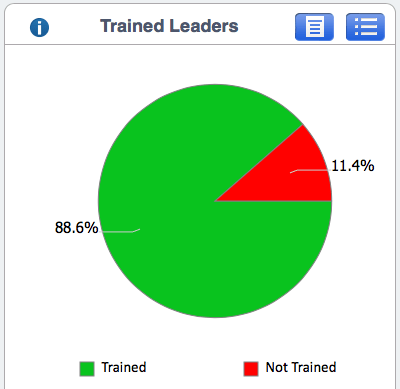
In July 2015, I posted an article regarding the poor status of training in North Star District. At the time, we had about 46% of our scouters having completed the required training for their positions. Rechartering for 2016 is complete. Now is a good time to take a look at how we have progressed.
Some of the problems in the July 2015 report were failures of record keeping. The Council’s centralized method of reporting and maintaining training records often caused lags or omissions in updating individual’s records. As a result, many scouters had completed training but it did not appear on their records. This meant that the statistics were inaccurate.
 With the advent of my.scouting.org’s allowing Unit Key 3 (Chartered Organization Representative, Unit Committee Chair, and Unit Leaders) and Unit Training Committee Chairs being able to update individuals’ records, we have been able to update old records very aggressively. This has solved many of the omitted-records problems.
Another problem we had is that units had no training program in place while district and council offered few training alternatives outside of University of Scouting or summer camp at Ransburg to cover these gaps in training. With district offering training at camporees and at unit meetings, this began to cut into this problem.
Now we can see the results, from 46% trained we are now at 88.6% trained.
Thank you to the many scouters who have helped achieve this astounding improvement in our numbers!
 CAC North Star Unofficial Website
You must be logged in to post a comment.