
National Council
Philmont opening
Greg Hoyes from our Troop 804 has forwarded this message from an Iron Horse District Troop:
Scout leaders on Philmont waiting list:
My troop was selected for a Philmont trek in 2016, expedition # 626A. The date is June 26th to July 8th , leaving Indy on 6/25 & returning 7/8. We are a small troop, 40 miles southeast of Indy in the Iron Horse District. The troops in Iron Horse have not filled up my crew and I currently have three spots open for scouts aged 14-20. I requested a waiting list from Philmont for the Crossroads of America council and your names were provided. We are planning on flying into Albuquerque and are having Blue Sky adventures provide ground transportation, meals and hotel with some sightseeing in Albuquerque, where we will spend one night to help get acclimated to the altitude. Total estimated cost of the trek, including transportation is $1775.00 , (Philmont: $870; Ground package: $465; Airfare (estimated at $440.) This will be my 5th trip to Philmont, so I am familiar with the Philmont adventure.
Contact me if any scouts in your troops are wanting to go to Philmont in 2016 and might be interested. I will be happy to provide any additional info and will sign anyone up on a first come, first serve basis. I can add scouts up February 22nd, as the final Philmont payment must be received by March 1.
Thanks for considering.
Regards,
John Bitner
Scoutmaster, BSA Troop 28
Iron Horse District
Arlington, IN 46104
BSA Licensing for Movies at Scout Reservations
We show movies at Scouting events from time to time . . . .
* * *
Some camporees, day camps and summer camps show movies, too.
Because of this, we need to be obedient and follow the rules about showing movies in public — and yes, those rules apply to the Boy Scouts of America even though we’re a nonprofit organization.
* * *
But starting now, the BSA has purchased an umbrella license through the Motion Picture Licensing Corporation that covers all council-owned properties.
The added benefit of this new umbrella license is that it covers all local council facilities and camps for the duration of the license: Nov. 1, 2015, to Oct. 31, 2016.
Anything from one of these studios. That’s a long list that includes Fox, Disney, Paramount, Warner Bros., New Line, NBC Universal, MGM, Marvel Studios and many more.
I’m told that roughly 95 percent of movies are covered by this list.
New Service Hour Requirements
Bryan on Scouting has an article about the service hours requirements effective on January 1, 2016. This is significant because it defines some types of work that must be part of the service hours. It also changes the number of hours.
Advancement Resources
Often we have questions about advancement issues. BSA puts out a great deal of information. Often this feels like drinking from a firehose.
One of the ways to avoid this problem is to be sure your unit’s advancement coordinator subscribes to the irregularly published BSA Advancement News. (Irregular because it is sometimes monthly and sometimes bi-monthly.) 
For a new advancement coordinator, catching up on old articles in the archive can be daunting. They may just want to look at specific issues of the moment. One of the best ways to do that is to review the Advancement News index of articles on the BSA Advancement website. The article titles are often catchy and artistic, but misleading about the main idea. Have patience with it. It is not intended to be a advancement manual (the Guide to Advancement serves that purpose). Instead it is intended to focus on hot topics.
If an advancement coordinator wants to study the history of advancement changes, he or she can read back issues of Advancement News. There is a lot to be learned to look at how a once “hot topic” was handled and resolved. It helps guide an advancement coordinator to have a better sense about how to handle future problems. The method of resolution will often be similar: the timeframe required to identify the issue then resolve, the groups giving input who have the most persuasive authority on the final result, and the types of issues that are resolved with finality versus lingering effects.
Always start with the Guide to Advancement, the most recent revision for the current year of Boy Scout Requirements, the most recent issue of Advancement News for answers, and the related Merit Badge Counselor’s Compass newsletter. If those prove unsatisfactory, review the News index. You may surprise yourself with the quality of answers that are already published.
If you still do not find your answers, reliable and regular private bloggers can provide insight, such as Clarke Green at www.scoutmastercg.com with a focus on scoutmastership, Frank Maynard at www.blogwhiteblather.com with a focus on committee issues, and the Ask Andy column at www.netcommissioner.com.
To subscribe to the Advancement News, follow these instructions:
Send an email to advancement.team@scouting.org.
Put ‘Subscribe’ in the Subject line and in the body of the email put only your:
Email Address:
Name:
Council Name:
Tufts University’s Study on Whether Scouting Works
Dr Richard Lerner has been doing a 2.5 year longitudinal study near his school of randomly selected 1800 scouts and 400 non-scouts. He started by studying the boys as the entered scouts. He was setting a benchmark as to whether scouting changes boys character. Dr. Lerner’s final report is out. The summary is available at Scouting Magazine’s website.
The results are stunning. It shows in “a compelling way,” according to Dr Lerner, that the BSA has a significant ways in a least six characteristics:
- Trustworthiness;

- Helpfulness;
- Kindness;
- Obedience;
- Cheerfulness;
- Hopefulness.
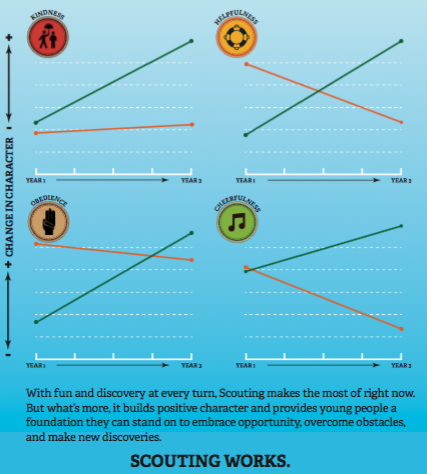
So what about being solely focused on sports? Unfortunately, the sports-focused kids took a hit in how well the kids prioritize values, particularly in their priorities in caring for other people. They are not as interested in other people’s well-being, as were scouts. This effect becomes more pronounced as the boys stayed in scouting.
News from Council Operations Meeting
Last night, Tuesday, October 20th, Council held their semi-annual Operations Meeting. North Star was represented by Mark Pishon as District Advancement Chair, Brian Crow as District Camping Chair, District Commissioner Jeff Heck, and District Executive Con Sullivan. We were not able to cover the break out sessions for Programming, Family Friends of Scouting, Activities, or Communications due to lack of representation.
Vice President for District Operations Stroh Brann opened the meeting. As a past Wood Badge Course Director, he recognized our most recent past Wood Badge Director Jason Creighton of currently of Del-Mi District, formerly of our own Pack 358.
Carolyn Small recognized one of our recent White Stag Course Directors (whose name I did not catch).
They then had a short introduction of the STEM Scout program which is currently rolling out in beta testing in the Crossroads  of America Council. One of its District Executives Zach White announced that the Council took delivery of the new Vortex truck the previous day. I had an opportunity to walk through it. The tools’ delivery is expected in the near future.
  The STEM DE told us a little bit more about the program. The unit in STEM Scouts is a called a “Lab.” The first “Lab Manager” position specific training is November 2nd from 1 pm to 5 pm at the Scout Center. This a great opportunity to learn the program from the inside.
Break-out Session Reports
Membership. The Council Commissioner and the Membership Committee held a joint break out to discuss recruitment and retention. Field Services Director Rob Hemmelgarn provided data on recent trends in the Council for the past 5 years. In that period of time, the retention rate has improved from 66.6% year-over-year in 2010 to 69.2% in 2014. Current projections for 2015 are 70.9%. We are doing an increasingly better job of retaining scouts once we recruit them.
The bad news is that our recruiting and market penetration is down markedly in that same period of time. In 2010, we had 903 traditional scout units. In 2014, we had 757: a loss of 146 units across the council. In 2015, we are projected to loss another 50. This unit loss has had a direct impact on scout recruitment. In 2010, we recruited 9,307 new scouts. In 2014, we recruited 6,779. In 2015, we hope to stay level, but we have only recruited 5,104 as of September 30, 2015.
Many ideas were thrown around about the cause of problems, but the numbers seem to indicate that poor Tiger Cub and other Cub recruiting is hurting all programs. Since 95% of Boy Scouts come from Cub Scouts, this Cub Scout recruiting problem is having a cascading effect on all scouting programs as the years pass.
Rob reported that nearly all youth programs from scouts to athletics are reporting similar declines. Questions were raised about financial explanations. Rob reports that the professional literature is pushing the notion that it is attributable to video games. This writer wonders whether the video game explanation is just a symptom of financial issues. Video games have a larger up-front fixed cost and smaller costs to continually upgrade or add games. It requires no additional time away from home. It allows parents who are busy at work to make sure their kids are occupied with a significant investment of time from the parent. This works well in financially struggling households to allow more work time without additional child care costs or investments in time and effort.
The question in recruitment has a marketing component, a sales component, a training component, and a first-60 days retention component. These components were all alluded to but not answered.
Upcoming Council Events
The next Council meeting is the Cub Scout Promotional Team Kickoff on October 29th at Camp Belzer. November 2, 2015 is the first day of Cub Scout Camp registration for summer 2016.
Council has meetings on November 15th and December 15th for the Activities and Training Committees and the Commissioners at the Scout Center. Start time is 7:00 pm.
The Governor’s Luncheon is December 14th at the JW Marriott hotel.
Cub Leader Training
Don’t forget to get your new leaders trained online at My.Scouting.org or with in-person classes from Council and its Districts as listed at the new Council Training Hub website. This training is required for Rechartering.
If you run a training session, please add it to the new Council Training website.
Neckerchief as Class B Uniform
Did you see the new announcement about a neckerchief as a Class B alternative?
Notice of maintenance upgrade on my.scouting.org
August 12, 2015MyScouting Tools Maintenance
On Thursday, August 13, from approximately 8 AM to Noon CT, MyScouting Tools will be inaccessible. During this timeframe a maintenance notification will be displayed on the webpage. This maintenance will make improvements to the My.Scouting data base. Please direct any questions to the Member Care Contact Center at 972-580-2489.
Need to Schedule Self-Assessment Meeting
This year, the Journey to Excellence (“JTE”) scorecard will be required in Rechartering. In April District Commissioner Jeff Heck emailed a link to a self-assessment form to each unit. An article about this email was posted on this blog.
JTE and the self-assessment are two parts of the same process . National council’s goal with JTE is to encourage units to become more self-aware of what elements of their programs work well and what elements need a boost. JTE scorecard is designed to help units see where these elements in a simplistic scoring method. The self-assessment is designed to take those simplistic scores and translate them into actions that improve the unit in a meaningful way.
Let’s take a look at what has been recent experience versus how this process is supposed to work. We will use the example of a Cub Pack.
Before JTE and self-assessments, the Pack Key 3 (i.e., Chartered Organization Representative (“COR”), Pack Committee Chair, and Cubmaster) were expected to sit down and agree on the principles and personnel used to run the Pack. They were expected to read through all of the manuals for Cubmasters, Committee Members, and COR and figure out what needed attention. What often happened is that some of the Key 3 had read everything, some had read only what applied to them, and others read nothing. When the Key 3 did meet, there was no clear agenda on what the Pack’s principle focus for improvement should be.
 Where a Unit Commissioner was assigned to the Pack, the Commissioner would sometimes offer some verbal guidance or an outline on how to proceed. More often than not, especially in North Star District, the Pack Key 3 neither knew what a Commissioner was or who was assigned to the Pack.
With the new JTE and self-assessment combination, the Pack is asked to have a dedicated meeting for the Pack Key 3 and the Unit Commissioner every six (6) months. The agenda is to review the a self-assessment form with focus on identifying the Pack’s strengths and weaknesses today and designing a plan for improvement over time. The self-assessment form emphasizes identifying specific areas that a healthy pack needs to thrive. Within those areas, the Key 3 are asked to describe what specific tasks that they would like to undertake, who will be delegated primary responsibility, and when the deadline for completion will be.
This process is designed to mimic the business planning processes of any healthy organization. The process is broad in scope of what needs to be reviewed. The process is systematic in its regular method of assessment to avoid complacency or reckless ignorance. The process is brief in documentation necessary. The process is clear on delegation and responsibility to avoid confusion or omission.
With these a self-assessment forms in hand, JTE scoring should be much similar. The categories in the JTE scorecard and the self-assessment match up nearly identically. Within an outline of an action plan from the self-assessment form in mind, the JTE scorecard’s intent and focus is much easier to decipher. The expectation is that a regular self-assessment with clear delegation of responsibility and accountability will make the scores on the JTE scorecards go up as a natural consequence of successful planning.
Rather than using the sample form on this page, please print out your own form from the link emailed to you (or contact your Unit Commissioner to send you a new link). This form from my.scouting.org will be automatically populated with some of the BSA’s records about your unit. This will allow you to double check your unit’s records versus BSA’s and make sure that you know your unit’s training status.
The District Commissioner’s Service is working hard to prepare our units for October’s rechartering and the added requirements of preparing the JTE scorecard. Please discuss with your unit’s Key 3 when they can meet to review your self-assessment and invite your Unit Commissioner to attend. Attend a District Roundtable or Commissioner’s Coffee to learn more.
 CAC North Star Unofficial Website
You must be logged in to post a comment.