
REMINDER: Roundtable Thursday
Thursday after general session, Andrew Linden will speak about promoting your unit using Social Media.
Please join us for general session at 6:30 pm with district-wide announcements and discussions followed by Andrew’s presentation.
Roundtable is held at Luke’s Lodge, the outbuilding on the Northeast corner of campus at St. Luke’s United Methodist Church, 100 W 86th St, Indianapolis, IN 46260.
Service Hours Reporting Problems
At the last District Committee meeting on February 4, 2016, District Executive Con Sullivan reported that there is a bit of confusion about service hours reporting. Even this writer has been guilty of the confusion.
Apparently there are two separate service hour reporting websites. They do not share data!
The national website, accessible through my.scouting.org, reports directly to National Council and is used for your unit’s national statistics such as contribution to the World Movement of Scouting’s billion service-hour challenge, but not Journey to Excellence scoring.
We know this is a problem because many of our largest and most successful troops have reported zero service hours on one or both of these websites. At the same time, these units have had Eagle Scouts reporting hundreds if not thousands of service hours. The scouts are getting proper credit, but it is not passing on to the units.
Journey to Excellence has a separate scoring for service hours which can receive a separate gold-level recognition.
Make sure your unit secretary or registrar is reporting service hours to both National on my.scouting.org and the same data to the local website at https://docs.google.com/forms/d/1v7vmkVA0iDiQKTG4u-m8tG8lsHaGKwMrQbd93olBHig/viewform?edit_requested=true which is linked on the front page of http://www.crossroadsbsa.org.
To prevent this being a problem in the future, District will be reviewing these statistics quarterly. For troops, we will be looking at Eagle project reports against unit reports. Discrepancies will be pointed out to units.
For Cub Scout Packs, we will be looking at zer0-hour reports as needing updating.
Remember, we are part of a world-wide effort to demonstrate the value of scouting to our communities. Your reports help that marketing effort.
Planning for JTE 2016
Based on District’s 2015’s success with JTE, we need to begin planning for 2016’s success.
Journey to Excellence is designed to do more than congratulate successful units.
Journey to Excellence is designed to help units plan the program year, evaluate the unit’s strengths and weaknesses, and provide clarity about what characteristics make a succesful unit.
In order to obtain the full benefits of JTE, a unit should look at the 2016 JTE Scorecard now and begin planning for this year’s success.
The unit should also plan for the Unit Key 3 to meet with their Unit Commissioner in the next 60 days. To do so, review my.scouting.org for your Unit Commissioner or contact District Commissioner Jeff Heck for more information.
Let’s try for 100% unit gold in 2016!
Gold Everywhere in 2015
 The Journey to Excellence program is designed to encourage best practices from all units, districts, and local councils. BSA summarizes the scoring system in its brochure:
The philosophy from the start of JTE has been to set up a system where 10 percent of the councils will achieve gold status, the next 40 percent will achieve silver status, and the next 30 percent will achieve bronze status. Therefore:
• Gold status = top 10 percent
• Silver status = 50th percentile to the 89th percentile
• Bronze status = 20th percentile to the 49th percentile
With this background in mind, we are thrilled to report that our units’ success with JTE this year has made a significant impact on local scouting.
North Star District had 22 units reach gold, 7 reach silver, 2 reach bronze, and 3 tender no report. Of the 3 that did not report, most would have been gold or silver.
As a result of your efforts to report the unit JTE status, we have had a significant impact!
North Star District made District Gold for the first time in years!
Not only that, North Star District making District Gold pushed Crossroads of America Council the last couple of criteria across the Council Gold threshold! (It was touch-and-go down to the last calculations.)
This means that the simple act of your units reporting their annual efforts and successes results in all of Central Indiana’s scouting being nationally recognized as one of the 10% of local council’s nationwide.
Do not underestimate the value of your unit’s contribution to the larger story of scouting!
Congratulations North Star District and Crossroads of America Council.
What is a “Boy-Led Troop”?
A phrase I hear often is apparently heard many times by other scouters, too.
Clarke Green writes, “Many Scouters claim, ‘We have a boy-led troop’ but what does that really mean? ‘Boy-led’ is not what adults do, it’s what they don’t do.”
He goes on to write,
Defining what we should not do is nowhere near as useful as sharing what weshould do, but before I do let’s address one common misconception;
Boy-led is not boy-defined.
Every once in a while I’ll hear something like; “We don’t have patrols because the Scouts decided they didn’t want them, we are boy-led after all.”
Imagine a basketball game where the players were carrying the ball rather than dribbling. You ask a coach why and they tell you; “the players all decided they’s rather play this way.” Can you still call that game “basketball”?
Just like any other game Scouting has limitations and definitions. We all play the game within those definitions and limitations, the players don’t re-invent the game.
Adults should help Scouts maintain focus on fulfilling the promises of Scouting and understand the limitations and definitions of the game we are playing.
One of the commenters, Richard Andersen, adds, “I personally don’t like the term ‘boy-led,’ I prefer scout-led.”
Mr. Andersen really helps to clarify Clarke’s point extremely well. If the troop is “boy-led,” there is not inherently a strong sense of limitation of what the “boys” can do in defining the troop. On the other hand, describing the troop as “scout-led” always requires that the scouts revisit the idea of what it means to be a “scout.” Using the word “scout,” emphasizes the importance of working the system of scouting. It clarifies the difference between a scout’s choice following the Scout and what their friends would do outside without the Scout Law guiding their choices.
As modern-day scouters, we often see scouting as another extracurricular activity that a boy does.
When Baden-Powell opened the first scout encampment at Brown Sea Isle, the first thing he did was to put the boys “on their honor” to live within the scout system. For Baden-Powell this oath of honor set scouts apart from other boys.
Marketing Unit as a Method of Scouting
In the last several articles, we have considered seven-touch marketing and social media as methods of marketing your unit and recruiting new scouts. This is leading up to the February Roundtable with Unit Commissioner Andrew Linden discussing social media marketing.
Marketing can be done on paper, on the internet, or in person. Let’s focus on the power of in-person marketing.
The best salesman for scouting to a young boy is his best friend, who is already a scout. Baden Powell set up scouting as an opportunity for boys to naturally gravitate into their preferred social group — a group of 5-7 boys with similar interests. In his book Scoutmastership (1920) he explains that scouting uses this natural tendency to teach character.
As the Boy Scouts of America built its system, it developed a list of methods that scouters are encouraged to use to develop character in boys and girls. One of those methods is “Adult Association,” which is described as “Boys learn from the example set by their adult leaders. An association with adults of high character is encouraged at this stage of a young man’s development.”
Imagine your son has wonderful camping experience and wants to tell everyone about it. You hear him telling his friend within earshot of the friend’s mother. Maybe he is describing rappelling.
REMINDER: District Committee Meeting
Our February District Committee Meeting will be Thursday 7:00 pm at Second Presbyterian Church, 7100 N Meridian St, 4th Floor, Indianapolis, IN 46260.
We hope to see you there!
“God Bless America” and BSA
Did you see this great article on “Bryan on Scouting”?
Irvin Berlin a Silver Buffalo? Cool!
Marketing your Pack or Troop
One of the biggest mistakes that many units make is that they rely on new members to simply appear.
Recruitment is not a magic act. New scouts will not just appear. They join. They need to believe in the unit they are joining. They need to feel an emotional bond with the pack or troop.
Recruitment is a conscious and planned effort to have new scouts . . . and their parents . . . feel an emotional bond with the pack or troop.
Experts in marketing often recite the refrain of requiring “Seven Touches.” (It is so fundamental that whole marketing companies are named for the concept.) The concept is that a person will not build trust with any person, group, or organization without having had seven opportunities to learn about it.
What do those seven opportunities look like?
These seven opportunities vary widely in character. They can include a mailed flyer, a scout in uniform waving from across the street, a casual story about weekend activities with a friend or business associate, a simple conversation about scheduling conflicts, an email, a Facebook or social media posting, public webpages, placing information on http://www.BeAScout.org, paid advertisements, a follow-up phone call, a thank you note to a visitor, face-to-face networking, a table at a community event, etc.
Unfortunately most scouting units do none of these. They don’t use social media. They don’t update their profile on http://www.BeAScout.org. They don’t encourage members and adults to tell stories about their scouting adventures to friends and family.
This failure to tell the scouting story is a phenomenon that has grown progressively worse over the decades.
I grew up in scouting in the 1970’s and early 1980’s. Following the publication of the 1972 edition of the Boy Scout Handbook, there was an attempt for scouts in uniform to hide their participation in scouting from the outside world. The post-1960’s mindset disliked soldiers and police in uniform. The theory was that scouts in uniform were not viewed favorably by association with adults in uniform. The BSA did not emphasize uniforms or broad publicity. They relied on the Norman Rockwell paintings and good feelings from parents as veteran scouts.
As a result we have nearly two generations of scouters and scouts who don’t like to tell their story in public.
What was the past experience of publicity about scouting?
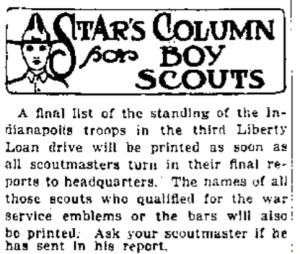
From about 1912 to 1933, both the Indianapolis Star (daily morning paper) and Indianapolis News (daily evening paper) ran a weekly column on scouting. Essentially it was the weekly newsletter of the Indianapolis Council. The result of this column was that the entire Indianapolis readership was exposed to scouting.
In other sections of the paper, reports of scout troop activities and fundraisers would be listed. Often troops or district like our own North Star District would advertise upcoming fundraisers like “yard parties.” The most surprising part of these scout reports is the inter-troop competitions, like basketball games, would be reported in a manner similar to modern high school basketball box scores.
Now imagine a young boy and his parents. With the regular newspaper placements and publicly prominent events involving scouts, do you imagine that the troops needed to work very hard to explaining what scouts do?
I would imagine that the excitement came naturally. The young boy and his parents already had enough information to ask informed questions. Young mothers in 1931 had brothers or male cousins who had been scouts, so they had experienced a scout’s home life.
Post-1972 scouting suffers from a lack of information among its target audience. Many young mothers and fathers have no relatives who were scouts. They have pre-conceived ideas about what is scouting.
The problem is compounded because of scouting’s history of being perceived as a middle-class activity. People who grew up with lower incomes or in foreign countries may know even less about BSA activities.
Foreign-born parents may presume BSA units are more like units at home. For families from India, one of mother tells me, scouting is associated with wealthier families and learning military organizational skills. Some Latin American countries have similar expectations.
A pack or troop hoping to recruit a new scout first has to unravel many myths before new stories have accurate meaning for these young mothers and fathers.
Yet instead of unraveling these myths or inaccurate mental images, many scouts and their parents are afraid to tell friends and families that they are in scouts. “Being a boy scout” is often treated as an insult.
Consequently, our packs and troops need to find a way to persuade uninformed families how scouting would serve their scouts and parents well.
Having seven repeated opportunities to change scouting’s image allows a prospective scout to be persuaded in small doses over a longer period of time. A smiling scout in uniform at the McDonald’s may be contact no. 1. A Facebook picture of another scout in uniform laughing from the end of rappelling rope may be contact no. 2. A sign posted in the yard inviting the neighborhood to a sign-up night may be contact no. 3. A YouTube video of an Eagle Scout Court of Honor may be contact no. 4. A mention of scouting at a Scout Sunday service may be contact no. 5. A sign-up table at the school may be contact no. 6. A visit to the pack or troop meeting may be contact no. 7.
The Cubmaster or Scoutmaster may feel like a master salesman in persuading the new scout to join on the scout’s first visit. Yet, the sale on scouting was not made at the meeting.
The sale was made in seven separate pieces.
In the modern era, scouting rarely serves as the neighborhood little league, except in Varsity Teams (scouts aged 14-18 and focusing on sports). Consequently, scouting now competes with little league.
The seven-touch marketing method helps to allow scouting to move to the front of the prospective scouts’ and his parents’ minds amid the clutter of other extracurricular activities.
The successful scouting unit will consciously make these communications and opportunities to touch prospective scouts quietly. The unit will create and maintain a social media presence on Facebook (come see Unit Commissioner Andrew Linden at the February Roundtable lead a discussion on social media; details below). The unit will encourage families to post pictures of scouting adventures on social media and link to the unit’s social media page. The unit will encourage scouts to tell their scouting stories at dinners or holidays to the family, including younger brothers, aunts, uncles, grandmothers, grandfathers, cousins, etc. The unit will encourage parents to visit weekend activities and to share their experiences with their co-workers.
Then when sign-up night comes around or a young boy is curious about scouting, the decision to join is simpler and faster. The scout is more likely to be retained.
To be able to make these conscious plans takes organization and some knowledge of the internet. Roundtables will be teaching some of the skills that you need to build a successful seven touch marketing plan.
Come to the February Roundtable at Luke’s Lodge, the outbuilding on the northeast corner of the campus of St Luke’s United Methodist Church, 100 W. 86th St, Indianapolis, IN 46260. Unit Commissioner Andrew Linden will lead a discussion of effective use of social media as part of this seven-touch marketing.
In late April 2016, Council will announce its Fall 2016 marketing strategy. Be Prepared to integrate your unit’s social media efforts into Council strategy.
Scout Sunday: Feb 7, 2016
This Sunday is Scout Sunday. Hopefully your unit has made some plans to participate. If not, it is not too late. Simply
 having your boys agreed to attend one service together in uniform, regardless of denomination is a major contribution. A small contingent in uniform is usually The desirable enough target that any minister would want to recognize the group from the pulpit.
Another alternative is to work hand in hand with the pastor to become an integral part of the service. It may be a simple matter of greeting attendees. It may be helping the ushers. In any case, the idea is to be a participant in the service.Similar ideas can be done for Scout Shabbat for members of synagogues.
To learn more, see the link to Bryan on Scouting.
 CAC North Star Unofficial Website
You must be logged in to post a comment.